Iain M. Banks by Paul Kincaid
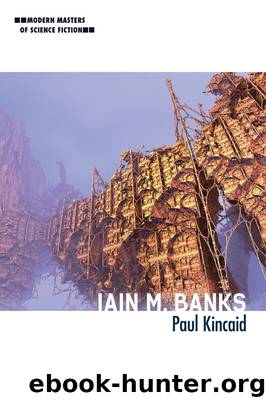
Author:Paul Kincaid
Language: eng
Format: epub
Publisher: University of Illinois Press
Published: 2017-04-10T04:00:00+00:00
APPROACHING THE WORLDGOD
It was more than a year after Look to Windward appeared in the United Kingdom before it was published by Pocket Books in the United States. Consequently, Gerald Jonas reviewed it in the immediate aftermath of the attack on the World Trade Center. Inevitably, he saw comparisons between the events of 9/11 and a novel that concerns a terrorist plot to kill billions, a plot intimately connected with the twin destruction of the two novas. “What Banks has to say about idealism, fanaticism, revenge, blame and forgiveness made as much sense to me as the news and analysis that blared nonstop from my television set,” Jonas said, and “what’s important in Banks’s work is the subtext, which I take to be the idea that freedom is both necessary and dangerous, and that only by imagining the unimaginable, both in ourselves and others, can we hope to remain free.”1
Any connection between Look to Windward and the events of 9/11 was, of course, no more than coincidence. Nevertheless, in a book written nearly two years before the fact, he seems to have caught the spirit of the times far more effectively than in books in which he consciously tried to reflect that moment. Banks’s next mainstream novel, Dead Air (2002), for instance, specifically references the attack on the twin towers, and other recent news events, in the way he had in The State of the Art. Yet Dead Air was one of the least well-received of Banks’s novels. Stephen Poole, writing in the Guardian, was typical. The attack on the twin towers looms over the book, he says, “but the novel does nothing with it; it is merely set-dressing. One of the few direct references—when Ken refers to ‘the fundamentalist intensity of those who secretly guess they may well be wrong’—just seems spectacularly incorrect, the sort of comfortable liberal solipsism (no one can seriously think differently from the way we do, can they?) that a more sophisticated novel might have tried to anatomise.”2
As it happened, Dead Air also marked the end of one stage of Banks’s career. He took a one-year break from writing fiction, during which he produced Raw Spirit, ostensibly a travel book about the whisky distilleries of Scotland, though it was far more a hymn of praise to fast cars and old friends. He followed this with The Algebraist, and then there was nothing for three years. This stuttering final act was precipitated by a string of changes affecting, to very different degrees, both Banks’s life and his writing. In the summer of 1998 he had been involved in a near-fatal car accident; “Typically, he emerged from the wreckage beaming, with cuts and bruises, to tell a horrified Italian couple who had stopped to help: ‘Thank God for airbags!’”3 By good fortune, he suffered no major injuries, but it is the sort of incident that prompts a reevaluation. On March 21, 2003, in protest at the way the government of Tony Blair was pushing the country into
Download
This site does not store any files on its server. We only index and link to content provided by other sites. Please contact the content providers to delete copyright contents if any and email us, we'll remove relevant links or contents immediately.
| Fantasy | Gaming |
| Science Fiction | Writing |
Sita - Warrior of Mithila (Book 2 of the Ram Chandra Series) by Amish(54877)
The Crystal Crypt by Dick Philip K(36860)
Cat's cradle by Kurt Vonnegut(15343)
Always and Forever, Lara Jean by Jenny Han(14904)
Ready Player One by Cline Ernest(14652)
The Last by Hanna Jameson(10252)
Year One by Nora Roberts(9788)
Persepolis Rising by James S. A. Corey(9353)
The remains of the day by Kazuo Ishiguro(8986)
Never let me go by Kazuo Ishiguro(8884)
Red Rising by Pierce Brown(8765)
Dark Space: The Second Trilogy (Books 4-6) (Dark Space Trilogies Book 2) by Jasper T. Scott(8177)
The handmaid's tale by Margaret Atwood(7761)
The Circle by Dave Eggers(7108)
Frank Herbert's Dune Saga Collection: Books 1 - 6 by Frank Herbert(7066)
The Testaments by Margaret Atwood(6883)
Legacy by Ellery Kane(6654)
Pandemic (The Extinction Files Book 1) by A.G. Riddle(6533)
Six Wakes by Mur Lafferty(6245)
